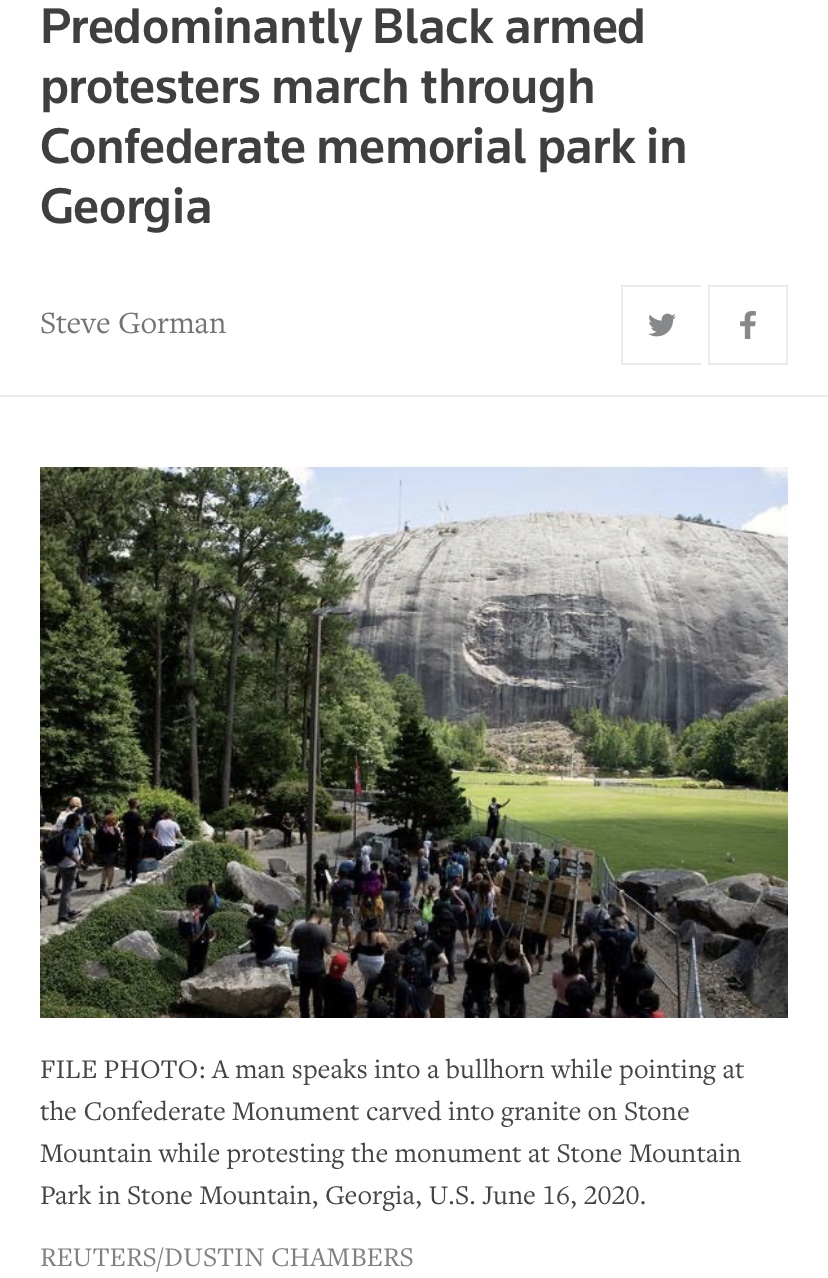
Protesters marched armed through Stone Mountain Park

www.reuters.com/article/us-global-race-usa-stone-mountain/predominantly-black-armed-protesters-march-through-confederate-memorial-park-in-georgia-idUSKBN24605G

(Reuters) – A predominantly Black group of heavily armed protesters marched through Stone Mountain Park near Atlanta on Saturday, calling for removal of the giant Confederate rock carving at the site that civil rights activists consider a monument to racism.

Video footage of the Independence Day rally posted on social media showed scores of demonstrators dressed in black – many in paramilitary-style clothing and all wearing face scarves – quietly parading several abreast down a sidewalk at the park. 

Many of the protesters carried rifles, including military-type weapons, and some wore ammunition belts slung over their shoulders. Although African Americans appeared to account for the vast majority of the marchers, protesters of various races, men and women alike, were among the group.

Support the movement.

If you are able to, please support your local Black led organization. If you are unsure who to support, here are some organizations who focus on abolition that we might suggest.

Black Lives Matter #BlackLivesMatter was founded in 2013 in response to the acquittal of Trayvon Martin’s murderer. Black Lives Matter Foundation, Inc is a global organization in the US, UK, and Canada, whose mission is to eradicate white supremacy and build local power to intervene in violence inflicted on Black communities by the state and vigilantes. By combating and countering acts of violence, creating space for Black imagination and innovation, and centering Black joy, we are winning immediate improvements in our lives.

Color of Change Color Of Change is the nation’s largest online racial justice organization. We help people respond effectively to injustice in the world around us. As a national online force driven by more than 1.5 million members, we move decision-makers in corporations and government to create a more human and less hostile world for Black people in America.

The Movement for Black Lives Black humanity and dignity requires Black political will and power. In response to the sustained and increasingly visible violence against Black communities in the U.S. and globally, a collective of more than 50 organizations representing thousands of Black people from across the country have come together with renewed energy and purpose to articulate a common vision and agenda. We are a collective that centers and is rooted in Black communities, but we recognize we have a shared struggle with all oppressed people; collective liberation will be a product of all of our work.

Black & Pink Black and Pink was founded in 2005 on the principles of abolition to dismantle the criminal punishment system and to liberate LGBTQIA2S+ people/people living with HIV/AIDS who are affected by that system, through advocacy, support, and organizing.

Redneck Revolt’s John Brown Solidarity Fund 100% of the donations to the John Brown Solidarity Fund are distributed to other community defense projects to help them take root and grow. In particular, we are interested in supporting the work of armed/militant community defense projects organized by folks of color in ongoing logistical and material needs as well as any other needs such as legal and medical aid. 

TGI Justice TGI Justice Project is a group of transgender, gender variant and intersex people—inside and outside of prisons, jails and detention centers—creating a united family in the struggle for survival and freedom.

Why should white folx be opposed to white supremacy?

Originally published: https://www.redneckrevolt.org/about

White supremacy is a system of violence and power that ensures that political, economic, and social power is withheld from people who aren’t white.

White working class people have all benefited to a certain extent from the system of white supremacy that exists within the United States. However, this same system and our participation within it have also ensured that white working class people will stay poor and relatively powerless in this society.

The greatest threat to those that pull the political and economic strings in this society is a unified resistance movement among poor and working class people. The vast majority of those that live in the United States, have relatively no power over the decisions and conditions that affect our lives. The overwhelming majority of those that live in the U.S. are poor or working class. We are the ones that see our paychecks (if we happen to even get one) gutted, our pensions and benefits dry up, our communities destroyed by drug abuse and poverty related crimes, and our entire lives spent struggling to just survive.

In the moments when white working people have looked beyond their skin color and have worked alongside movements of poor and working class people of all races, the power of the ruling elite has been the most directly threatened. It is when the working class has started to view itself in terms of class and racial solidarity that liberation has waited just around the corner.

White supremacy is a system that white working people have helped protect, but it is also used as a tool against all working people, with people of color impacted the most severely. Allegiance to a politics of white racism has only allowed the rich to continue to hold onto power, with no lifting effect to working class folks of any race.

The History of the Confederate Flag and What It Represents

Originally published in Teen Vogue, February 23, 2020
By: Jameelah Nasheed

Wherever you grew up in the United States, you’ve probably seen the Confederate flag. Perhaps on a bumper sticker or license plate, or hanging outside a home or government building. You may have seen it at school, like 15-year-old Aleah Crawford, when in 2019, she led a protest to ban the emblem as part of the dress code. Or you may have seen it on the news, when watching coverage of events around the country — such as the 2017 white nationalist rally in Charlottesville. Many of us have seen it, but here’s what you need to know about where it came from and how it became one of the most divisive symbols in U.S. history.

When did it first appear?

During the Civil War, the Confederacy had three official iterations of its flag — none of which resembled the flag we now think of as the Confederate flag. The flag — a red background with a blue St. Andrew’s Cross and 13 white stars that represent the states of the Confederacy — was the battle flag flown by several Confederate armies. One of those armies was led by General Robert E. Lee — an often romanticized figure in U.S. history, who led an army whose soldiers kidnapped free Black farmers and sold them into slavery, encouraged the beating of slaves who tried to escape, and fought to protect the institution of slavery. With his surrender at Appomattox Court House, the Civil War came to an end. Though Lee later distanced himself from the flag — requesting that it not be displayed at his funeral during a time in which the flag was used to commemorate Confederate soldiers — after his death, the flag became widely used by various groups and organizations that opposed civil rights.

How was it used post-Civil War?

The Dixiecrat political party, founded in 1948 and composed of white Southern Democrats who advocated for racial segregation, used the flag as their symbol to represent resistance to the federal government — meaning resistance to civil rights being granted to Black people. It has also been used throughout the decades by white supremacist groups, including the Ku Klux Klan (KKK).

In 1956, two years after the Supreme Court ruling in Brown v. Board of Education had declared school segregation to be illegal, the state of Georgia incorporated the battle flag into its official state flag as a symbol of resistance to integration. In 1960, when six-year-old Ruby Bridges became the first Black child to attend an all-white school in the South, she was met by crowds of white people who threw stones at her, called her the N-word, and waved the Confederate flag.

“White Southerners did not so much reinterpret the meaning of the flag as much as they rediscovered a meaning that had always been present going back to the war itself,” wrote Civil War historian Kevin Levin in a 2016 article about the flag for The Daily Beast.

How is it used today?

In June 2015, when 21-year-old Dylann Roof shot and killed nine Black people in a Charleston church after joining them for prayer, the Confederate flag was flying outside the South Carolina statehouse, where it was installed in 2000. In a manifesto Roof published online, he’d expressed wanting to start a “race war” and was photographed stomping and burning the American flag and waving the Confederate flag. Roof’s brutal act renewed debate about the flag’s meaning and use in public spaces. Activist Bree Newsome ripped down the flag at South Carolina’s statehouse before it was permanently taken down weeks after the shootings.

The following year, in May 2016, the U.S. House banned Confederate flags from being flown at cemeteries run by the Veterans Administration. In addition, major retailers, including Wal-Mart, eBay, and Sears stopped selling it, and various flag manufacturers have also ceased production of it.

Despite these changes, there are still Confederate flag defenders who insist that it isn’t a racist symbol. In December 2019, Nikki Haley, the former South Carolina Governor and United Nations ambassador (who actually ordered the flag removed from the Charleston statehouse), was criticized after saying Roof “hijacked” the Confederate flag, and that to the people of South Carolina, the flag represented “service and sacrifice and heritage.”

What heritage does it honor?

White Southerners who support the use of the flag say it’s representative of their Southern heritage. But for many African Americans, the Confederate flag is a symbol of their Southern heritage as well: one of terror, torture, and oppression. They interpret the flag the same way Roof did, and presumably the same way as those who waved the flag during the Civil War, during the Civil Rights Movement that followed, and at present-day events like Charlottesville and MAGA rallies. In honoring their ancestors with that flag, Black civil rights leaders say White Americans are honoring the pain and suffering that Black Americans’ ancestors endured and continue to endure more than 150 years after Lee’s surrender at Appomattox.